
Although the family foundation is a relatively new vehicle in Polish law, it enjoys considerable popularity among founders who want to secure the continued operation and succession of the family business. In this post, we discuss the general rules governing the taxation of a family foundation.
Taxation of beneficiaries [PIT]
The beneficiaries of a family foundation [hereinafter: FF] are natural persons or public benefit organisations named in the FF’s statute and/or on the FF’s list of beneficiaries, entitled to receive benefits of a specified kind from the FF. The founder may also be a beneficiary of the foundation.
How benefits received by beneficiaries from the FF are taxed for PIT purposes depends on which tax group the beneficiaries belong to under the Inheritance and Donation Tax Act.
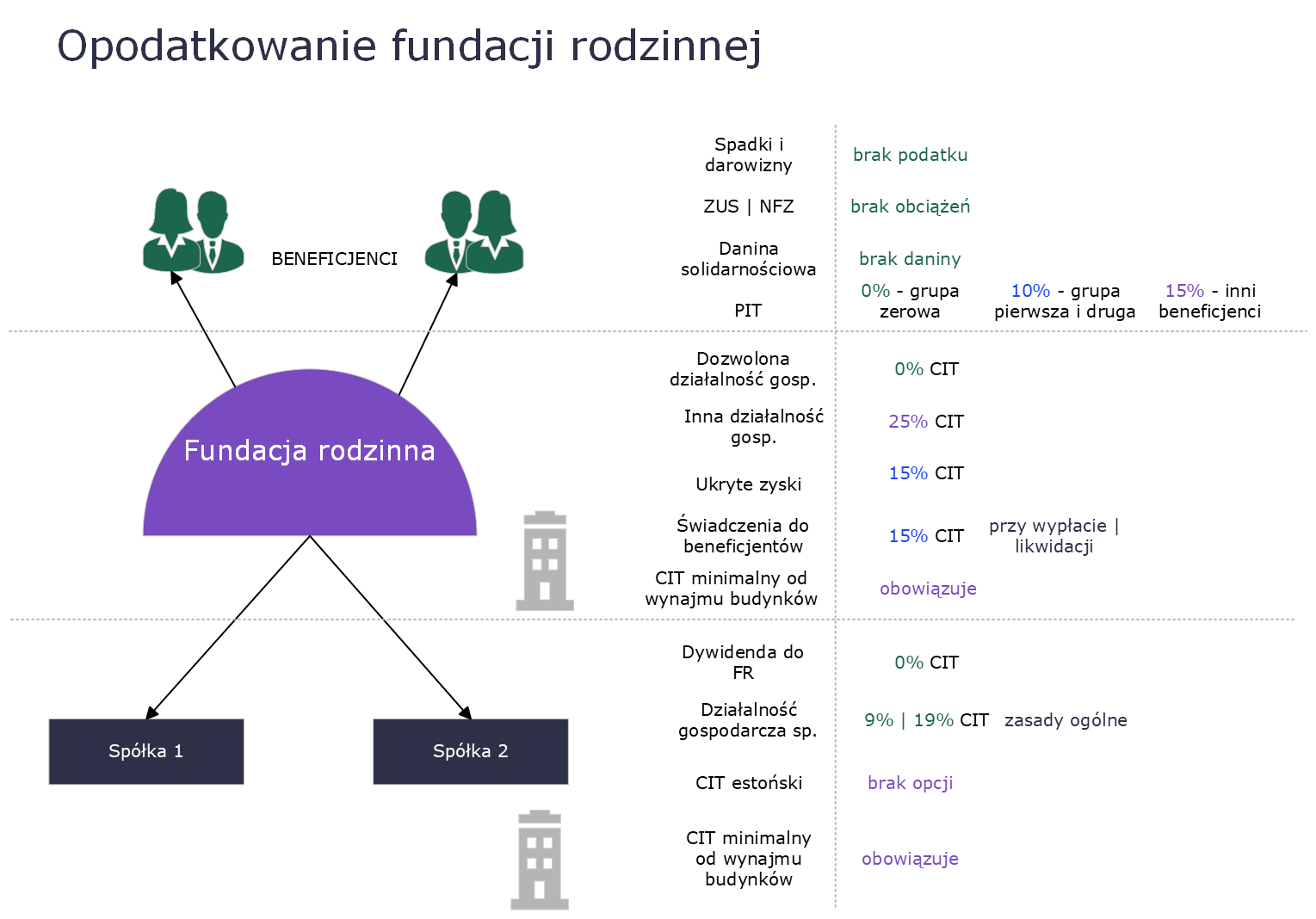
Beneficiaries in the so-called zero group are exempt from PIT on benefits provided to them by the FF.
Beneficiaries in the so-called first and second groups pay 10% PIT on the benefits they receive.
All other FF beneficiaries, in turn, must pay PIT at the rate of 15%.
Importantly, the PIT is collected by the FF, which in these cases acts as the remitter of the tax. This is also important from the perspective of the foundation’s accounting, which must record the distributions appropriately.
Exemptions from other taxes and contributions
Importantly, FF beneficiaries enjoy a number of other tax exemptions. In particular:
- they are not subject to inheritance and donation tax
- they are exempt from the solidarity levy
- benefits are not subject to social security or health insurance contributions [ZUS, NFZ]
Diagram of family foundation taxation
Taxation of the foundation’s activity [CIT]
The foundation’s CIT position depends on the type of business activity it carries on. As long as the FF’s business activity falls within the catalogue of permitted activity, the foundation is not subject to CIT on an ongoing basis.
CIT arises only when benefits are paid out to beneficiaries or when the foundation is liquidated, and it takes a flat-rate form [with no ability to recognise tax-deductible costs]. The rate of tax on benefits has been set at 15%.
The 15% tax will also apply where the FF pays out so-called hidden profits to a beneficiary or the founder.
Where, in turn, the FF carries on business activity going beyond the permitted catalogue, the legislator has provided for CIT at a punitive rate of 25%. A comparison with the standard CIT rate applicable to the activity of other taxpayers [19%] makes its punitive character plain.
Taxation of dividends paid to the foundation
Family foundations may be shareholders in companies that carry on business activity. Dividends paid by those companies to family foundations should benefit from the CIT exemption, as that was the very rationale for introducing the family foundation provisions.
Complicated? See how we can help:
we keep the foundation’s accounting and tax books, and help establish the chart of accounts and the reporting structure for the foundation’s governing bodies
we advise on all tax aspects of establishing a foundation and of the business activity it carries on
in cooperation with the lawyers involved in drafting the family foundation legislation, we will help you open and register a family foundation